The shortest accurate version
ENTIA maintains a machine-readable economic identity infrastructure. During the documented July 2026 forensic window, automated systems repeatedly requested and received ENTIA-controlled resources at scale. The evidence supports access, delivery, volume, recurrence and persistence. It does not, by itself, prove training, storage, RAG, grounding, product integration, infringement or damage.
The case is therefore not framed as “bots are bad”. It is framed as a governed-continuation problem: if machine systems already consume maintained identity objects, the conditions for continued access should be visible, measurable and licensable.
What happened
ENTIA operates a corpus of 11.33 million resolved economic identities across ten countries. Each public ENTIA Home is a projection of a maintained identity object: legal or economic identity, source references, verification state, enrichment, canonical URL, HTML, JSON-LD, Markdown and machine-access governance signals.
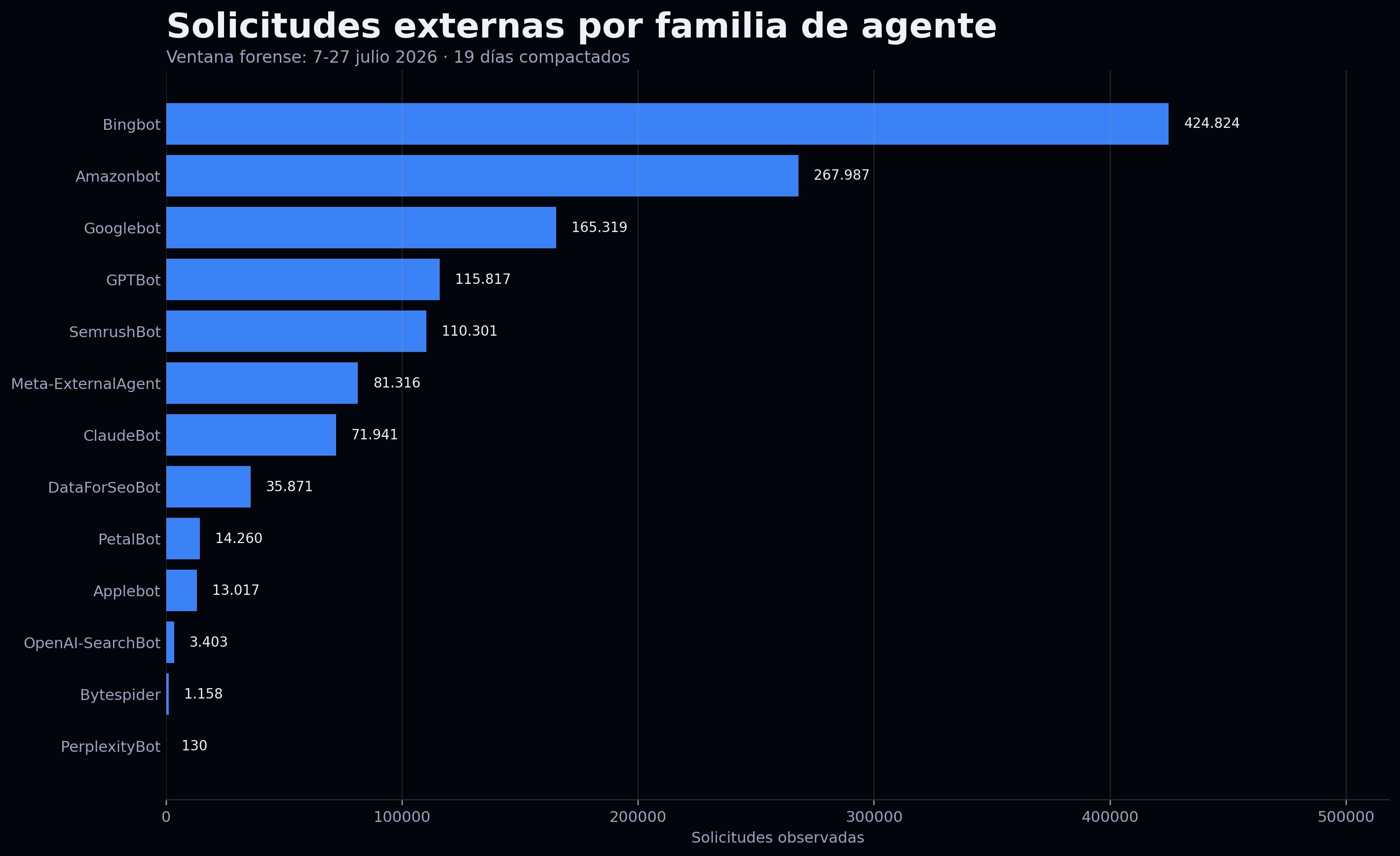
In the 7-27 July 2026 UTC observation window, the press pack classifies 1,343,701 external machine requests across 19 compacted days. Counting rule: gross machine traffic minus ENTIA's entia-pipeline-assert-bot (1,623 requests). The 11 and 12 July capture gaps are preserved as gaps and are not interpolated. Internal control traffic is flagged and isolated; it represents under 2 % of the baseline (9,104 requests, 0.68 %), and in this window it was carrying third-party agent labels. Figures under the unified counting criterion are published in the v7.0 changelog.
Evidence and limits
What the evidence supports
- Specified HTTP requests reached ENTIA-controlled infrastructure at recorded times.
- Clients declared specified User-Agent strings and requested specified routes.
- Response classes, transfer signals and route-level delivery were recorded where available.
- Activity was repeated and concentrated across search, AI, answer-engine, SEO and data-intelligence crawler classes.
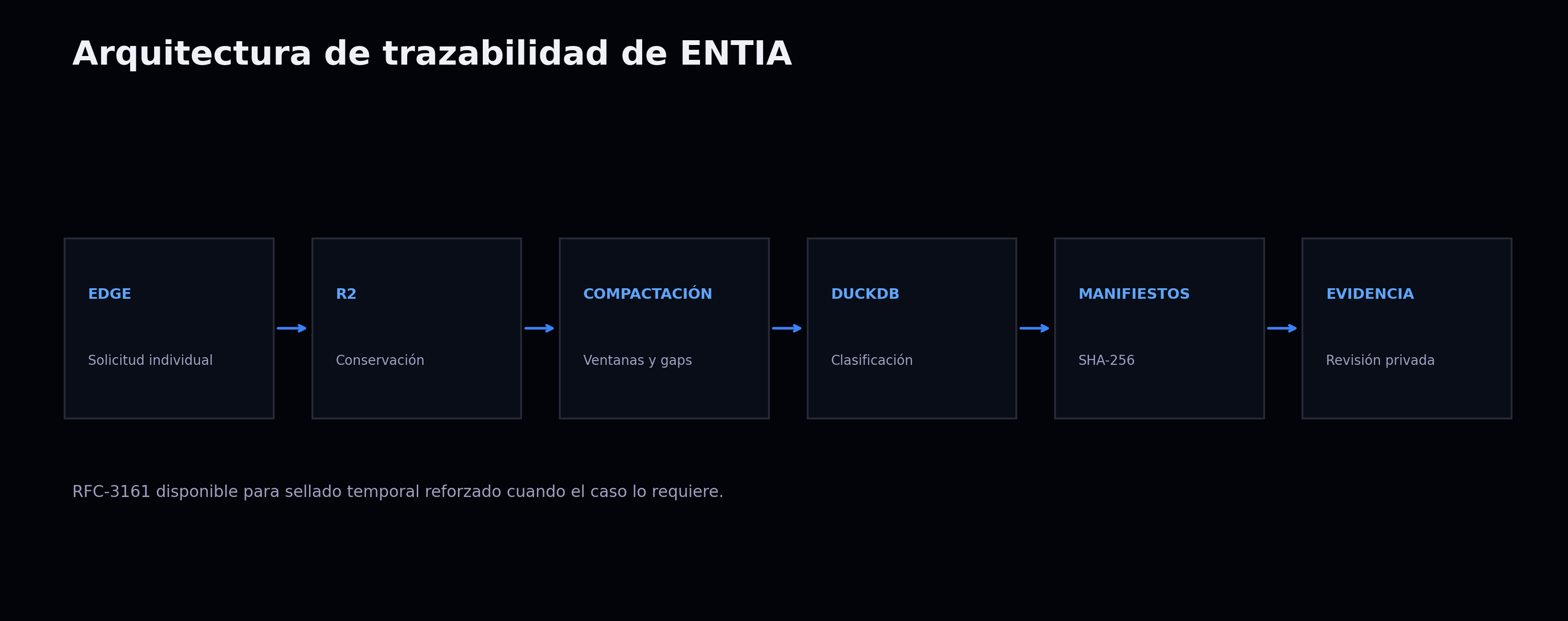
- Policy versions, telemetry aggregates, manifests and hashes can support reproducibility.
What ENTIA does not assert from telemetry alone
- Training, fine-tuning, model evaluation, embeddings or memorisation.
- RAG, grounding, internal retrieval or use in a specific answer.
- Integration into a particular product, workflow, model or customer deployment.
- Automatic infringement, contractual acceptance, damages or debt per request.
- Operator-level legal responsibility based only on a declared User-Agent string.
Declared agent landscape
The table reports families of User-Agent observed in the classified forensic window. “Association” means public association of that User-Agent family, not a legal attribution of each request.
| Agent family | Public association | Requests | Share of external |
|---|---|---|---|
| Bingbot | Microsoft | 424,824 | 31.62% |
| Amazonbot | Amazon | 267,987 | 19.94% |
| Googlebot | 165,319 | 12.30% | |
| GPTBot | OpenAI | 115,817 | 8.62% |
| SemrushBot | Semrush | 110,301 | 8.21% |
| Meta-ExternalAgent | Meta | 81,316 | 6.05% |
| ClaudeBot | Anthropic | 71,941 | 5.35% |
| DataForSeoBot | DataForSEO | 35,871 | 2.67% |
| PetalBot | Huawei | 14,260 | 1.06% |
| Applebot | Apple | 13,017 | 0.97% |
| Other external classes | Several / not highlighted | 41,048 | 3.05% |
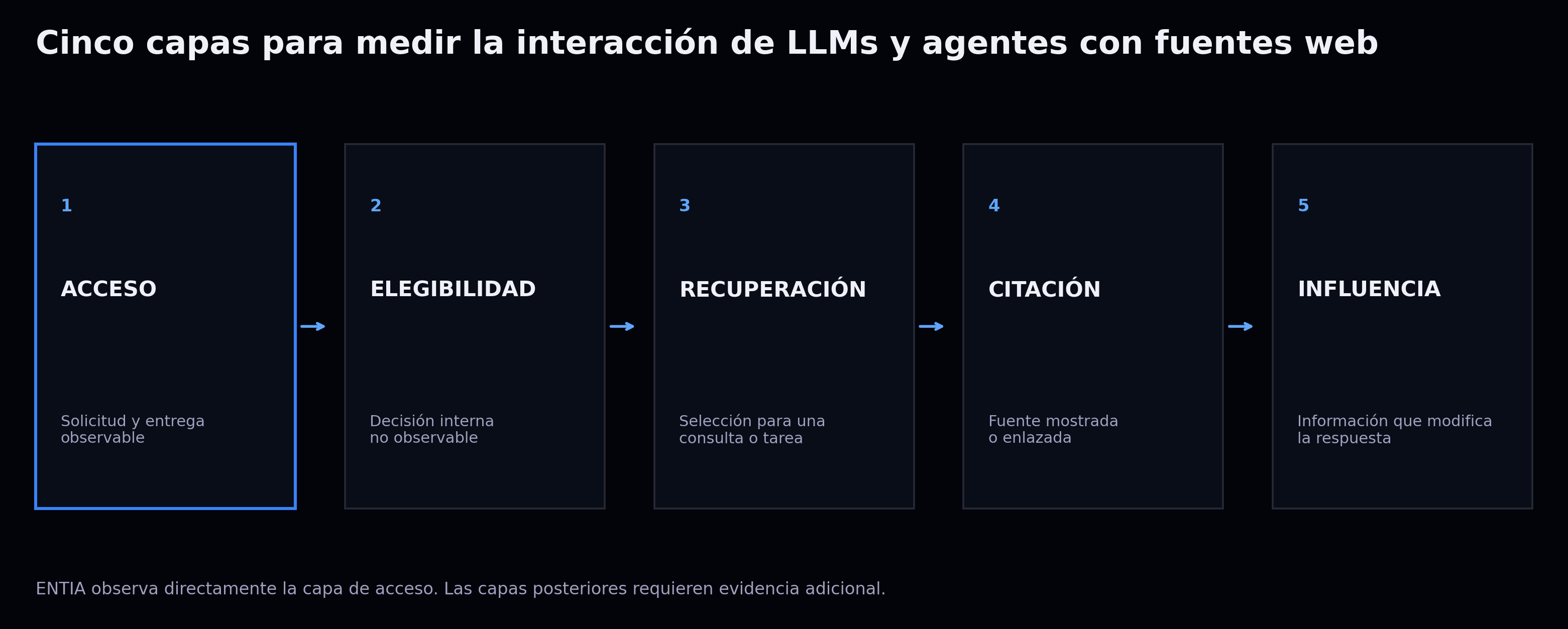
The five-layer measurement framework
ENTIA separates layers that are often conflated in public debate about AI visibility and crawler activity.
Why this is a European case
ENTIA is a global infrastructure with operational direction in Madrid and legal entity PrecisionAI Marketing OÜ in Estonia. EMAC is European because the case is framed through European copyright, database, AI, contract and interoperability mechanisms.
The legal architecture is layered: machine-readable TDM reservation for qualifying protected subject matter, sui generis database-right analysis where qualifying investment and extraction or re-utilisation conditions are established, separate treatment of ENTIA-owned software and enrichment layers, source-by-source rights review, and contractual continuation only after valid activation.
The European Commission's July 2026 TDM opt-out registry feasibility work is relevant because it examines how rights reservations can be expressed, identified and supported with technical infrastructure. ENTIA's contribution is a concrete operating case connecting corpus identity, machine-readable policy signals, access evidence and licensed continuation.
Governed continuation
ENTIA does not require operators to disclose whether the corpus supports search, indexing, training, evaluation, grounding, RAG or another internal function before activating the standard continuation route. The standard commercial sentence is simpler: the corpus may continue to be consumed in the same manner, but within an active economic licence.
Optional service layers such as authenticated APIs, managed feeds, delta delivery, provenance packages, rate arrangements and audit support may be offered separately. They are enhancements, not prerequisites for licensing the access already occurring.
Timeline
Approved quotes
"The access already exists. The licence enables its continuation."
"We are not trying to guess what happens inside models. We are documenting what leaves our infrastructure, who requests it and how often."
"Precision does not weaken the case. It makes it defensible."